- Block diagram
- Design considerations
- Design resources
- Product listing
- Support
Block diagram
Highlighted components are Nexperia focus products.
Input power protection
Power management
Gate driver
Signal processing
Communication Interface
Power Distribution unit (PDU)
Related applications (1)
Networking and NICs
Related applications (1)
Select a component
To view more information about the Nexperia components used in this application, please select a component above or click on a component (highlighted in blue) in the block diagram.
Design considerations
- The motherboard hosts, powers and interconnects processors, memory, storage and networking, requiring efficient power distribution and high signal integrity across dense layouts
- AI accelerators can be deployed on dedicated trays or connected via PCIe, requiring scalable power delivery and robust high-speed interconnect support
- Supply rails typically range from 12 V, 48 V or 54 V, with future systems moving toward 400 V and 800 V to improve distribution efficiency in high-power racks
- Power input protection must address surge, reverse polarity and inrush current using TVS diodes, ideal diodes, eFuses and hot-swap controllers, protecting both the server and the supply
- Power management requires multiple high-efficiency DC-DC converters with integrated switching to generate accurate voltage rails for processors and peripheral components
- Communication interfaces require low-capacitance ESD protection to maintain signal integrity, while buffers and transceivers support longer traces and reliable board-to-board communication
Design resources
Evaluation boards
NEVB-NEX40400EVM-12 - 40 to 5V, 600 mA, PFM, 2.1 MHz, synchronous step-down converter evaluation board
NEVB21-USBC1 - USB Type-C ESD protection evaluation board

NEVB-NBM7100A/B - LiMnO2 coin cell battery life booster evaluation board
NEVB-NPS3005 - 0.5-5.5 V, 6 A, 15 mΩ single channel load switch with soft start and quick output discharge
.png)
NEVB-NID1101 - 1.5-5.5 V, 1.5 A forward voltage blocking ideal diode evaluation board
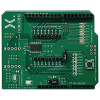
NEVB-NCA9555 - I²C controlled GPIO expander evaluation board
Reference designs
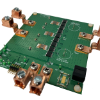
TI PMP23496 8 kW Hotswap
.png)
NEVB-NEX80806DA - 85-264 Vac to 24 Vdc, 1 A flyback converter evaluation board